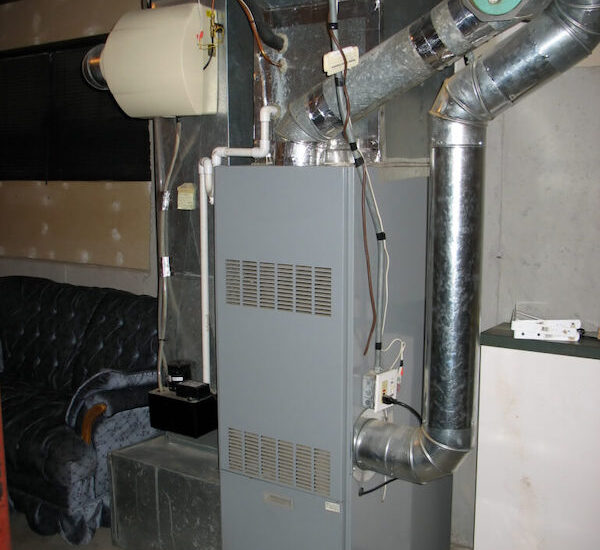
Repair a water heater when the tank is sound and a part has failed. Replace it when the tank body is leaking or the unit is past about 10 to 12 years old. Age and the condition of the tank decide most cases, because common repairs cost far less than a new unit: HomeGuide’s 2026 ranges put most single-part repairs at $100 to $350 and a standard 40 to 50 gallon tank at $600 to $3,100 installed. This guide covers the signs that point each way, what each path costs, when North Carolina requires a permit, and what Durham’s soft water means for how long your tank lasts.
Should you repair or replace your water heater?
Replace a tank water heater once it passes 10 years old, or at any age if the tank body itself is leaking. Repair it if the unit is under about 8 years old and the failure is a component: a thermostat, a heating element, a thermocouple, a gas control valve, or a pressure relief valve. Those parts are designed to be replaced, and the tank around them still has years left. Between 8 and 12 years, the right call depends on the tank’s condition and whether this is the first repair or the third. A leak from a fitting, valve, or connection is usually a repair. A leak from the tank body means replacement at any age, because internal corrosion can’t be patched.
Why the “50% rule” rarely decides it
The common rule says to replace a water heater when the repair costs more than half the price of a new unit. It’s a reasonable check, but with water heaters it rarely settles the question. Most single-part repairs run $100 to $350, while a standard tank costs $600 to $3,100 installed, so most repairs pass the test easily. A 15-year-old tank with a failed thermostat passes it too, and it’s still near the end of its life. That’s why age and tank condition tell you more than the size of the repair bill. On a tank past 10 years, the useful question is whether you want to pay for a repair now and a replacement soon after.
| Common repair | Typical cost estimate (HomeGuide, 2026) |
|---|---|
| Thermostat replacement | $100 to $350 |
| Heating element replacement | $100 to $350 |
| Thermocouple replacement | $100 to $325 |
| Pressure relief valve replacement | $50 to $300 |
| Anode rod replacement | $150 to $350 |
| Dip tube replacement | $100 to $300 |
| Gas control valve replacement | $150 to $550 |
| Flush and clean a tank | $75 to $250 |
| Flush and descale a tankless unit | $75 to $300 |
How old is too old?
Most tank water heaters last 8 to 12 years, and tankless units last 15 to 20. Those are the ranges we give customers. Past 12 years, a tank is beyond its expected life, and a repair usually buys months rather than years.
If you don’t know how old your water heater is, check the serial number on the manufacturer’s label. Most brands encode the manufacture date in the serial number, but each one uses its own format, so look up your brand’s decoder or ask your plumber to read it for you.
When a repair is the right call
Repair the unit when the tank is sound and a component has failed. These are the problems we see most often in Durham homes, and each one is a routine water heater repair:
- No hot water, or only lukewarm water. Usually a failed thermostat, a burned-out heating element, or a pilot that won’t stay lit.
- Rumbling or popping from the tank. Sediment on the bottom of the tank is overheating. A flush usually clears it.
- A dripping pressure relief valve or a leak at the cold-water inlet. Both are common and almost always repairable.
- Rusty water on the hot side only. Often a spent anode rod, which is a replaceable part. Act on it soon, because once the rod is used up, the tank starts to corrode.
- A tankless unit showing flow or ignition error codes. Usually mineral buildup, cleared with a descaling service.
When it’s time to replace
Replace the unit when the tank itself has failed or the repairs have started to add up. The clearest signs:
- Water seeping from the tank body. This is internal corrosion. A leaking tank tends to get worse, so plan on water heater replacement before it floods the space around it.
- Repeat service calls. Several repairs in the last year or two usually mean the unit is wearing out.
- Not enough hot water. If your household has grown and a 40-gallon tank no longer covers your mornings, a repair won’t fix a sizing problem.
- Rusty water on an older tank. Rust on a newer tank with a spent anode rod is a part problem. Rust on a 12-year-old tank usually means the tank is corroding.
If you can’t tell whether water around the unit is coming from a fitting or the tank, call for same-day leak detection rather than guessing.
What does it cost to repair or replace a water heater in Durham?
Most standard tank replacements fall between $600 and $3,100 installed, according to HomeGuide’s 2026 national cost guide, with tankless and hybrid heat pump units running higher. The ranges below are market estimates to help you budget, not A/C Medic’s prices. Your price depends on the unit, where it’s installed, and whether gas, venting, or electrical work has to change, so the number that matters for your home is the one on your written estimate.
| Job | Installed cost estimate (2026) | Source |
|---|---|---|
| Standard tank, 40 to 50 gallon | $600 to $3,100 | HomeGuide |
| Tankless water heater | $1,400 to $5,600 | HomeGuide |
| Hybrid heat pump water heater | $2,000 to $4,600 | HomeGuide |
| Venting a gas unit for the first time | Adds $500 to $1,500 | HomeGuide |
| Larger gas supply line | Adds $350 to $2,000 | HomeGuide |
| Removing and disposing of the old unit | $75 to $500 | HomeGuide |
What pushes a job toward the top of a range:
- Gas tankless units often need a larger gas line, dedicated venting, and electrical service, and condensing models need a condensate drain.
- Hybrid heat pump units need enough surrounding air to work well. ENERGY STAR’s installation guidance cites 450 to 700 cubic feet of space, or a louvered closet door, in a spot that stays between about 40°F and 120°F.
- Any tank may need an expansion tank, a new shutoff valve, a drain pan, or vent corrections to meet code. Attic and crawl-space installs cost more than garage installs.
The federal 25C tax credit that covered heat pump water heaters ended for equipment placed in service after December 31, 2025, so a guide promising a $2,000 federal credit is out of date. Duke Energy’s Smart $aver program in North Carolina still offers a $500 rebate on a heat pump water heater. To qualify, the unit must be ENERGY STAR certified with a uniform energy factor (UEF) of at least 3.3 and installed by a Smart $aver participating contractor, who submits the application within 60 days. Standard electric, gas, and tankless models don’t qualify. If the timing is bad, A/C Medic also offers financing through Wells Fargo, with approved credit.
Does Durham require a permit to replace a water heater?
Often, yes. North Carolina law exempts one narrow case. Under N.C. Gen. Stat. § 160D-1110(a)(2), replacing a water heater in a one- or two-family home doesn’t need a plumbing permit only if all of these are true:
- The work is done by a plumber licensed under G.S. 87-21, who personally examines the finished work and makes sure a leak test was performed on the gas piping.
- The new unit’s energy use rate or thermal input is no greater than the old one’s.
- There is no change in fuel, energy source, location, capacity, or the routing or sizing of venting and piping.
- The installation meets the current North Carolina State Building Code.
A homeowner doing their own swap doesn’t qualify, because the exemption depends on a licensed plumber doing the work. Moving the unit, going up in size, switching fuels, or converting to tankless also takes the job outside the exemption. Electric water heaters have a separate exemption for the wiring connection in subsection (a)(4), which requires an electrician licensed under G.S. 87-43 and a replacement of the same or smaller capacity and electrical rating in the same location.
Durham City-County Building & Safety’s plumbing fee schedule also lists “Electric water heater (permit required)” among fixture replacements. Before work starts, ask whoever is doing the job whether they will pull a permit, and have the answer noted on your estimate.
What does Durham’s soft water mean for your water heater?
Durham’s water is soft, which changes two common pieces of water heater advice. The City of Durham measured hardness at 22 mg/L in its 2016 water quality report, the most recent one that lists it. The USGS classifies anything from 0 to 60 mg/L as soft.
Sediment builds more slowly. Advice to flush a tank every year is aimed at hard-water areas, where scale builds quickly. Durham tanks still collect some sand, silt, and corrosion particles, so a flush is worth doing when the tank rumbles or during routine service, but hard water isn’t a reason to flush on a set schedule here.
A water softener won’t help your water heater. A.O. Smith’s technical bulletin on water softeners explains that softening replaces calcium and magnesium with sodium without lowering the water’s conductivity, and that it prevents the light scale that protects exposed steel inside the tank. Both effects wear the anode rod out faster. Bradford White also notes that softened water speeds up anode consumption.
What does help a tank last:
- Have the anode rod checked periodically and replace it when it’s spent.
- Set the thermostat to 120°F. The Department of Energy notes that lowering it from 140°F reduces scalding risk and saves energy.
- Keep household water pressure at or below 80 psi. North Carolina’s plumbing code (Section 604.8) requires a pressure-reducing valve when static pressure is higher than that, because high pressure strains the tank and its connections.
Tank, tankless, or hybrid?
A standard 50-gallon tank is the right choice for many Durham homes. It costs the least to install and is the simplest to service. Consider tankless if two or three hot water fixtures regularly run at once and you want the longer service life. Consider a hybrid heat pump unit if you have the space and want the lowest operating cost, especially with the Duke rebate.
The deciding factors are your household’s hot water demand, the fuel and venting your home already has, and how long you plan to stay. Our water heater replacement page walks through the trade-offs in more detail.
Frequently Asked Questions
My water heater is making a rumbling noise. Is that serious?
It’s worth a call but usually not an emergency. Rumbling is sediment on the bottom of the tank overheating. A flush typically clears it. Left alone for years, it can shorten the tank’s life.
Do I need a permit to replace my water heater in Durham?
North Carolina exempts a like-for-like replacement done by a licensed plumber in a one- or two-family home. Any change in fuel, location, capacity, or venting removes the exemption, and Durham’s fee schedule lists electric water heaters as permit-required. Ask your installer whether they will pull one.
Can I replace a water heater myself?
You can, but you give up the state permit exemption, since it requires a licensed plumber to do and check the work. Gas units also require a leak test on the gas piping and carry real safety risks. For anything involving gas, we recommend a licensed plumber.
Talk to a Durham plumber about your water heater
The fastest way to decide is to have someone look at the tank, confirm its age, and price both options. A/C Medic has served Durham and the surrounding Triangle since 2017, and our licensed plumbers handle both water heater repair and replacement. If a repair makes sense for your unit, we’ll tell you. If the tank is near the end of its life, we’ll tell you that too, and lay out the replacement options.
Call 919-694-0075 or schedule online. You can also see all of our plumbing services.
Related posts
 Air Conditioning
Why Is My AC Running But Not Cooling? A Durham & Raleigh Homeowner’s Guide
 Air Conditioning