
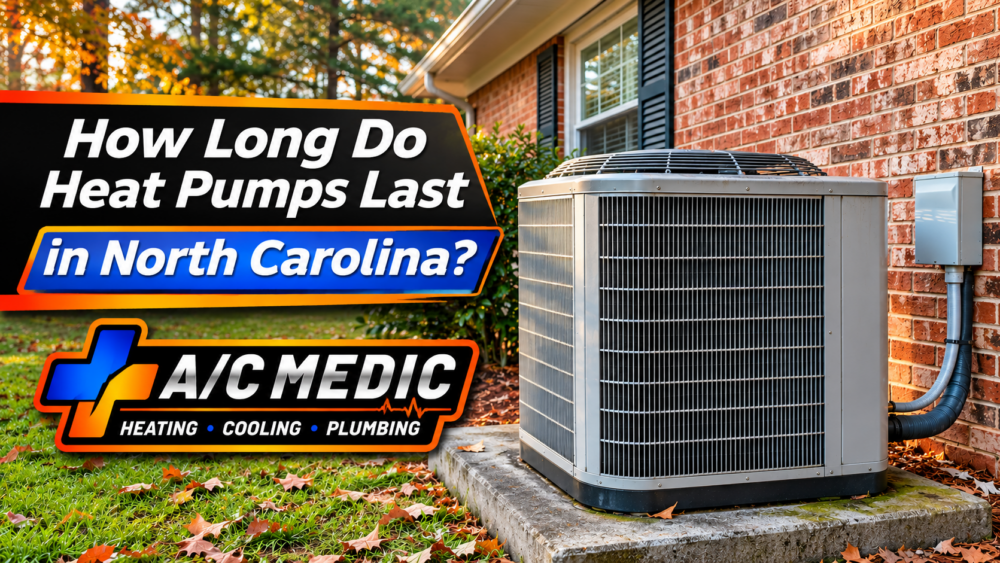
Quick Answer: Most heat pumps last 10 to 15 years. In North Carolina that number often lands at the lower end, because your heat pump runs for both heating and cooling all year instead of resting half of it. Good installation and twice-yearly service are what push a system toward 15 years or beyond.
Homeowners who ask how long heat pumps last in North Carolina usually want one number. The honest answer is 10 to 15 years, and where your system falls in that range depends mostly on how it was installed and how well you keep up with it.
Here is the part most articles skip. A heat pump in Durham works harder than a heat pump in a state where it only cools. Yours heats the house in January and cools it in July. That doubles the run time, and run time is what wears out a compressor.
How Long Do Heat Pumps Last on Average?
Trane puts the average life expectancy of a heat pump at 10 to 15 years. Ductless mini-split systems can stretch further, lasting 10 to 30 years depending on the same factors.
Those numbers assume a few things went right. A contractor sized the unit correctly for the house, installed it properly, and someone serviced it regularly. Miss any of those and the clock speeds up.
One more detail worth knowing. Trane notes that once a heat pump passes 10 years, it falls outside its warranty period, so repairs start costing you directly instead of the manufacturer.
Why Heat Pumps in North Carolina Wear Out Faster
Your heat pump runs nearly year-round here, and that is the single biggest factor working against it.
In the Triangle, plenty of homes rely on a heat pump as their only heating system. It does not sit idle through winter while a furnace takes over. It switches to heating mode and keeps going. Then summer arrives, humidity climbs, and it runs long cooling cycles for months.
Cold snaps add another layer. When temperatures drop far enough, your system switches on backup electric heat strips, and your power bill jumps. Many homeowners read that spike as a dying heat pump. Often the system is working exactly as designed. Our guide to heat pump defrost mode and emergency heat walks through what is actually happening on those mornings.
Does a Heat Pump Last as Long as a Furnace?
No. A gas furnace typically outlasts a heat pump, and the reason is run time rather than build quality.
A furnace works a few months a year. A heat pump works most of the year. More hours means more wear on the compressor, the fan motors, and the reversing valve.
That said, comparing the two in North Carolina is not simple. A furnace only solves half the problem. You would still need an air conditioner alongside it, and that unit ages too. A heat pump handles both jobs with one piece of equipment.
Are Heat Pumps Good in North Carolina?
Yes, and the climate is a big part of why. Our winters get cold enough to need real heat, but they rarely stay brutally cold for long stretches. That is the range where heat pumps work efficiently.
Homes across Durham, Chapel Hill, Hillsborough, and Mebane run heat pumps as their primary system for exactly this reason. In a climate with sustained subzero winters, a heat pump struggles. Here it suits the weather well. Gas furnaces are common in the area too, so you will find both.
The tradeoff is the shorter lifespan that comes with year-round operation. You get efficiency and one system instead of two. You give up a few years of equipment life.
What Makes a Heat Pump Last Longer in North Carolina
Three things separate a heat pump that reaches 15 years from one that quits at 9.
Installation quality. This matters more than the brand on the cabinet. A proper install starts with a Manual J calculation, which sizes the system to your specific house rather than guessing from square footage. Trane states plainly that an improperly sized unit or a shoddy installation can drastically reduce a heat pump’s efficiency and lifespan. An oversized unit short-cycles. An undersized unit runs constantly. Both wear out early.
As a certified Trane Comfort Specialist, our team runs that sizing calculation on every heating system installation we do, and we check whether the existing ductwork can handle the system before we quote it.
Regular maintenance. Change your air filter every one to three months. Schedule professional service twice a year, once in fall and once in spring. A heat pump that works in both seasons needs checking before both seasons.
How you run it. Keeping the house at 65 in July and 78 in January forces the system to work hard constantly. Setting the thermostat closer to the outdoor temperature reduces strain and buys you time.
Signs It Is Time to Replace Your Heat Pump
Age by itself does not mean replace. A 12-year-old heat pump running well is a heat pump you keep.
Trane points to three signs that matter more than the number on the data plate:
- Heating or cooling performance has dropped
- Breakdowns happen often, and repairs cost more each time
- Utility bills climb without a rate increase or a change in how you use the system
If all three are true, start planning for replacement rather than waiting for a failure in January. Trane also suggests considering replacement once a system passes 13 years and repairs become frequent.
The math gets clearer when a big component fails. A compressor or reversing valve on an 11-year-old system is a repair bill that buys you a year or two. Our guide on deciding between repair and replacement covers how to weigh that choice. If you are comparing equipment, our Trane product lineup shows what we install and why.
Get a Straight Answer About Your Heat Pump
A/C Medic has served Durham and the surrounding Triangle since 2017. We are licensed in both heating and plumbing in North Carolina, and we are a certified Trane Comfort Specialist.
If your heat pump is showing its age, we will tell you where it actually stands. Sometimes that means a repair that keeps it running three more winters. Sometimes it means planning a replacement before the system quits on the coldest night of the year.
Contact A/C Medic to schedule a heat pump evaluation.
